

In May 2023 I spent the better part of a month in Kazakhstan, figuratively speaking. I published three issues back to back: a Kazakhstan Primer, a piece on Halyk Bank called What Is Best in Life?, and Kazakh OS, about Kaspi. The Kaspi issue brought the biggest jump in subscribers this newsletter had seen. People love a superapp.
My verdicts were not subtle. On Halyk:
There is a nontrivial catastrophic risk in Halyk Bank and I would rather stay away.
On Kaspi:
Kaspi is a wonderful business with great management, trading at a very mediocre price.
I bought both anyway. But I had far more conviction in Kaspi, and my position sizing reflected this: Kaspi > 2.5x Halyk.
Three and a half years later, the tracking position has made about two and a half times more money than the conviction position.
Not in percentage terms. In absolute terms. The small bet out-earned the big bet that was 2.5x its size.
That result does not prove I was wrong. A small position in a stock with a real risk of disaster can be sound portfolio construction, and a good decision can still produce the worse outcome. But it made me go back and reread what I wrote in 2023, and what I found there is a mistake in process that I can demonstrate without leaning on hindsight. This post is about that mistake.
Spring 2023: Two Stories
Here is what the two looked like when I wrote about them.
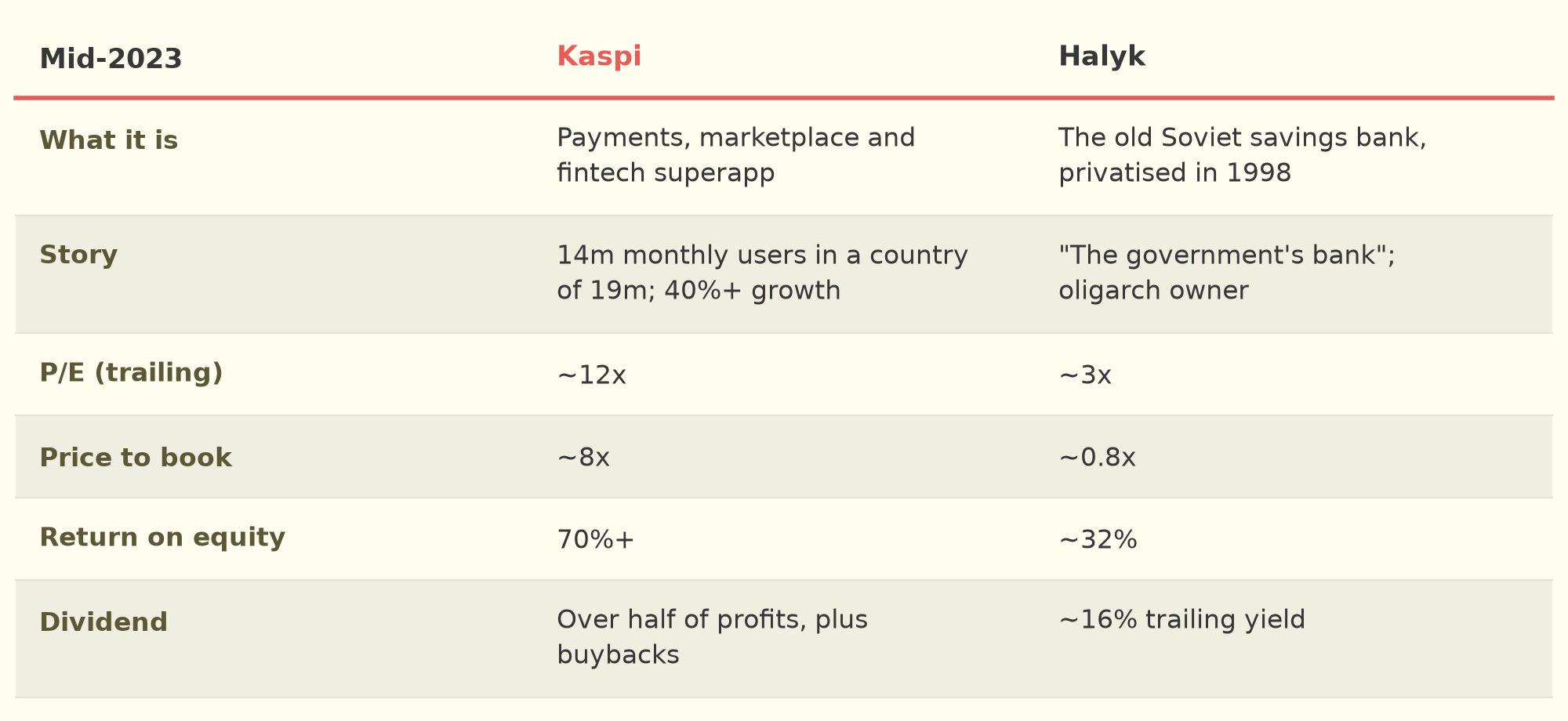
Kaspi was everything a quality investor wants:
network effects
a flywheel from payments to marketplace to lending
a founder-led management team
returns on equity that would embarrass a software company
a P/E you would normally see on a utility
My argument was that the Kazakhstan discount was simply too large for a business this good.
Halyk was everything a quality investor avoids:
a former state bank, founded in 1923 as part of Sberbank
majority owned by ALMEX, the investment vehicle of Timur Kulibayev and his wife Dinara, the former President Nazarbayev’s daughter
deposits concentrated in large state-linked companies
a board I described in my notes as “virtually 100% Russian educated”
Kaspi, the fastest-growing thing in the country, coming for its payments and consumer lending
I was not alone in seeing it this way. When Culper Research published its short report on Kaspi in September 2024, it made the same comparison from the other side: US investors, it said, cite Kaspi’s “seemingly low multiple of 11x earnings” while ignoring that Halyk “trades at just 3x earnings”. A short seller and I disagreed about Kaspi, but we framed the choice the same way. The only question was whether Kaspi deserved its premium.
The Scoreboard
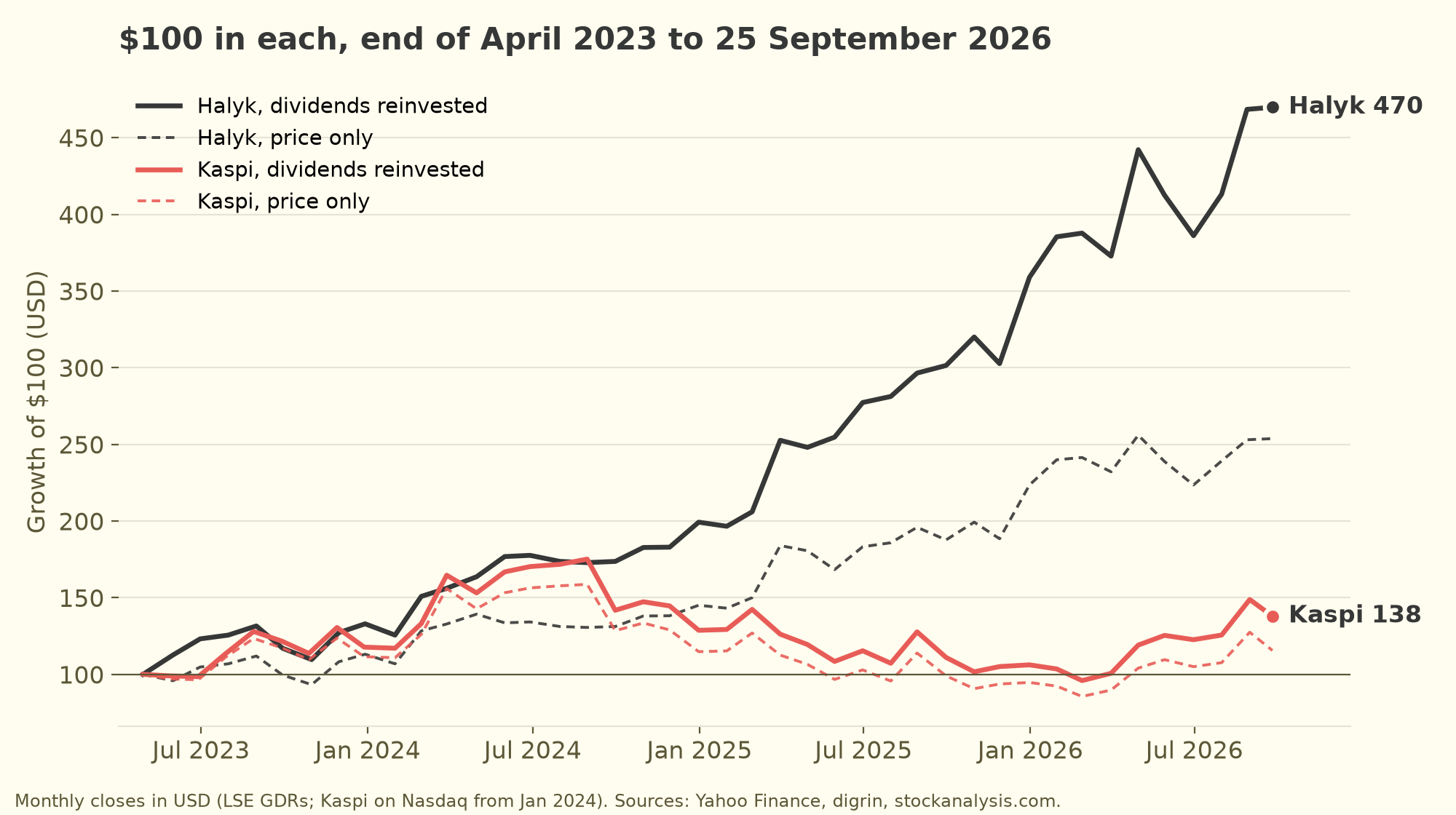
From the end of April 2023, just before my Kazakhstan series, to today:
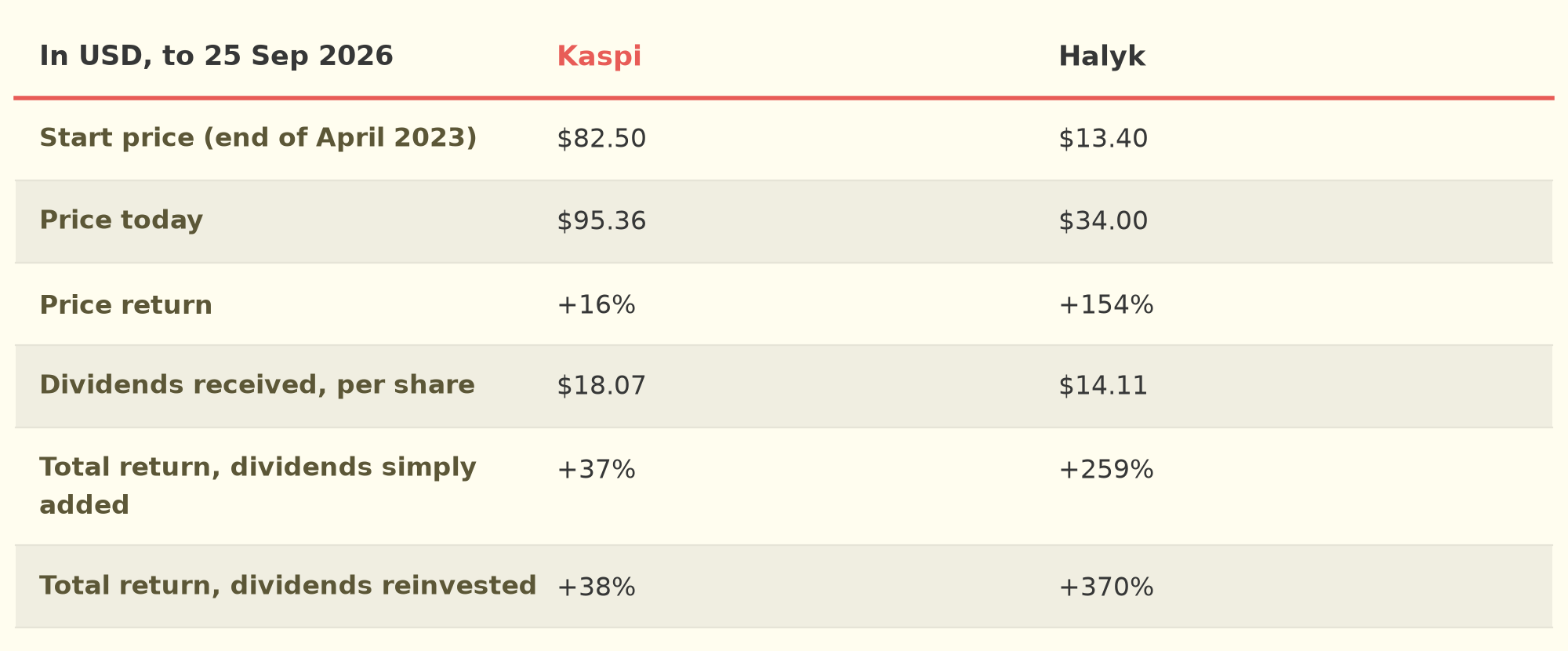
That is the like-for-like comparison of the two stocks. My own experience was a little different, because I bought on different dates. Measured from my actual purchase prices, Halyk is up about 183% on price and roughly 300% with dividends; Kaspi is up about 24% on price and roughly 45% with dividends.
Two things in that chart surprised me.
First, for sixteen months the two ran neck and neck. By August 2024 both had returned roughly 75% including dividends. Kaspi hit its all-time high of $138.72 in July 2024. The divergence starts in September 2024 and never reverses. Kaspi fell 50% from that peak to a low of $68.84 in March 2026, while Halyk marched to new highs almost every quarter.
Second, Halyk’s dividends alone returned more than its entire starting price. In just under three and a half years, a Halyk GDR bought for $13.40 paid out $14.11 in cash. Kaspi paid out about a fifth of its starting price, and nothing at all in 2025.
The currency was not the story. The tenge went from about 453 per dollar to about 431, a small tailwind for both, although it went through 547 on the way in October 2025.
The Surprise: The Growth Stock Did Not Out-Grow the Boring One
This is the chart I keep coming back to.
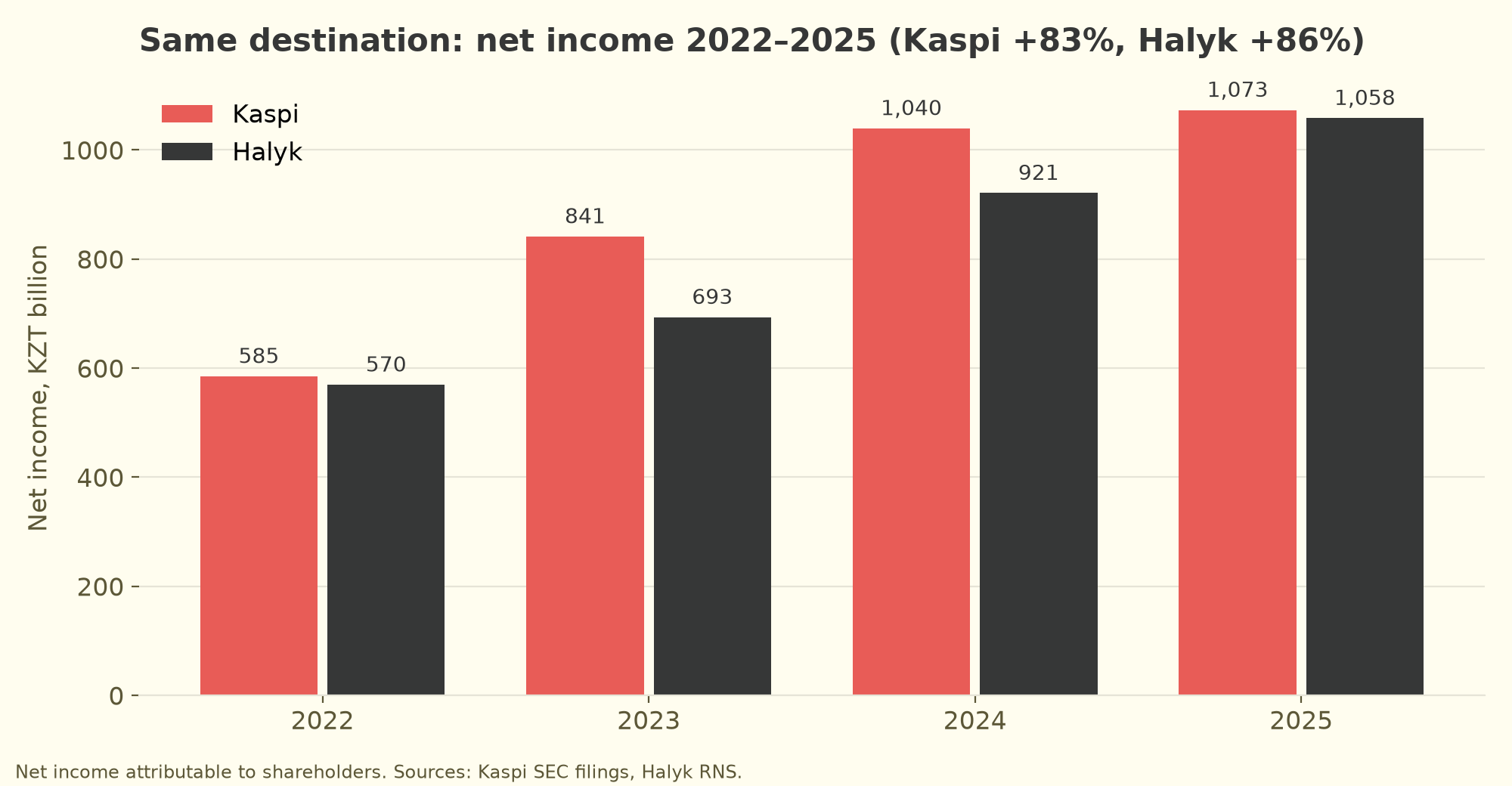
This is the chart I keep coming back to.
From 2022 to 2025, Kaspi’s net income grew 83%. Halyk’s grew 86%. They ended in almost the same place: about KZT 1.07T for Kaspi and 1.06T for Halyk.
The shapes are different. Kaspi grew fast early (+44% in 2023, +24% in 2024) and then stalled. Diluted EPS grew just 3% in 2025 and were flat in the first half of 2026. Halyk grew at a steadier 22%, 33% and 15%. But over the whole period, the company I paid 12x earnings for, and the one I refused to pay 3x earnings for, delivered the same growth.
A stock’s return is roughly earnings growth, times the change in the multiple, plus dividends. Split that way, the story tells itself:
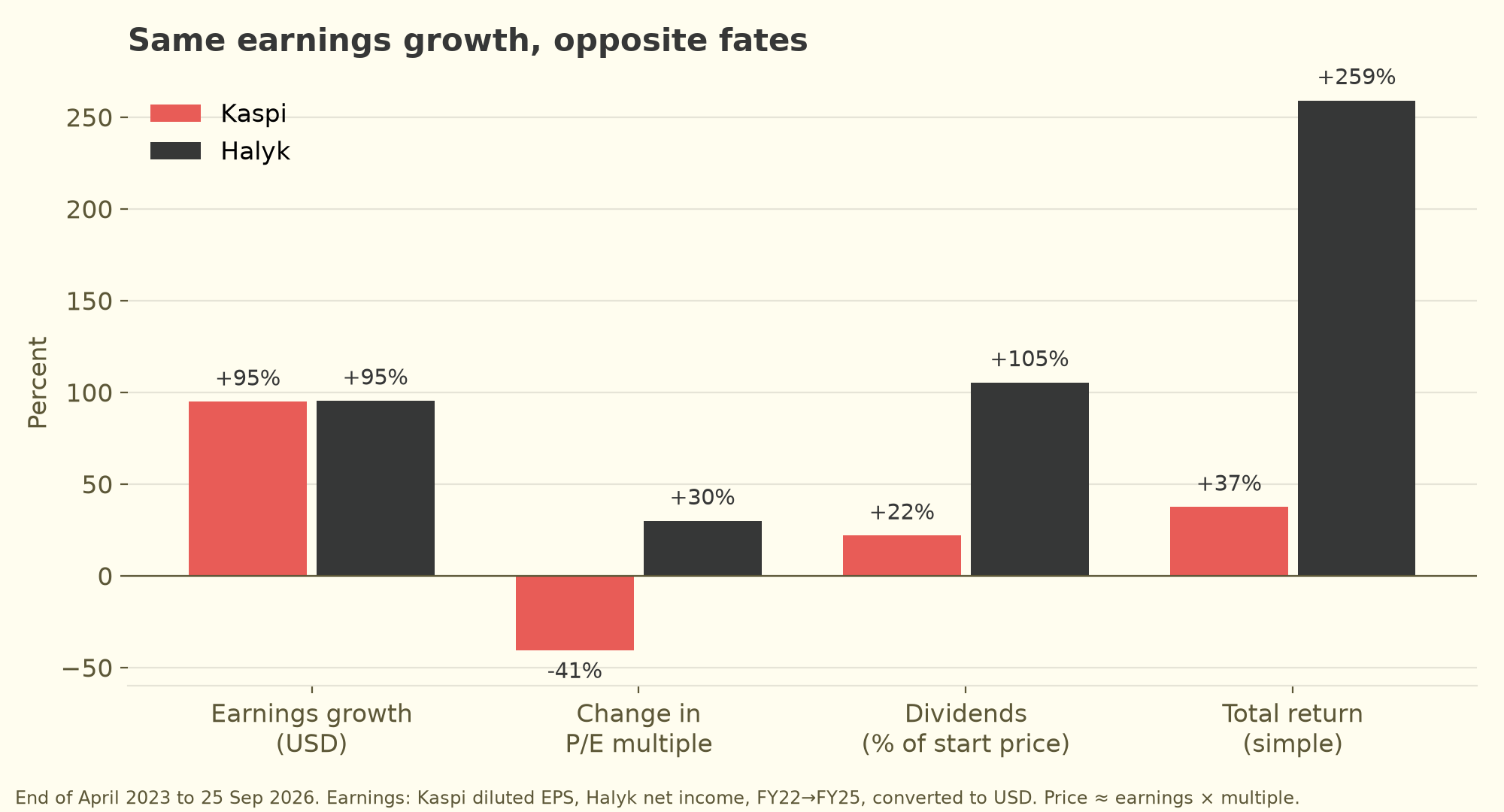
Earnings growth ($): +95% for both. Identical.
Change in P/E: Kaspi −41%, from about 12x to about 7x. Halyk +30%, from about 3x to about 4x.
Dividends (% of cost basis): Kaspi 22%, Halyk 105%.
Measured by earnings growth alone, Kaspi delivered: it roughly doubled its dollar earnings over this window. It just started at a higher multiple, not high in absolute terms but high relative to the Kazakh market, one that had a few more years of fast growth built in. When growth slowed, the multiple went with it. Halyk started at a multiple that assumed something bad would happen. Nothing bad happened, so its earnings growth went straight to the share price, and the dividends piled up on top
What Actually Happened
Kaspi’s growth at home halved, and taxes, regulation, and Hepsiburada absorbed most of the rest. When I updated my view after the Culper report in September 2024, I wrote that the report was not what worried me:
The real risk is how Kaspi continues growing from here given that user growth in Kazakhstan is tapped out. Everyone is a customer already.
Part of that played out. A company that has signed up the whole adult population cannot keep growing 40% a year at home. But Kazakhstan did not stop growing. It slowed, and the growth that remained leaked away before it reached shareholders. FY25 Kazakstan revenue grew 19%, Kazakhstan net income some 10%, but the group EPS was up only 3%.
The gap between Kazakstan revenue and Kazakstan profit is regulation and funding costs. The National Bank raised reserve requirements in 2025 and added a capital buffer on consumer loans in April 2026. From January 2026, Kazakhstan raised the corporate tax rate for banks from 20% to 25% and VAT from 12% to 16%. Marketplace growth guidance was cut from 25–30% to 15–20% in 2025.
The gap between Kazakh profit and group profit is Hepsiburada. Management went looking for growth abroad. It bid for Uzbekistan’s Humo payment system and withdrew. It bought 65% of Hepsiburada, Turkey’s e-commerce marketplace, for about $1.1B, closing in January 2025. It bought Rabobank’s Turkish subsidiary for about $300M, closing in July 2026. To fund it, shareholders waived the final dividend for 2024 and Kaspi paid no dividend at all in 2025.
Kaspi’s own guidance for 2026 is roughly 5% growth in adjusted EBITDA, including Hepsihubrada. And filings show the chairman, Vyacheslav Kim, reducing his holding since April.
Halyk did boring things well. It paid a dividend every year, added special dividends in December 2024, September 2025 and August 2026, and posted a record profit of KZT 1.06T in 2025. Its payout crept up to around 60% of earnings.
The risk I feared most has not shown up, at least not yet. I worried that Halyk’s owner might fall out of favour with the new president and the bank could lose its state deposits overnight. That has not happened. In November 2025, ALMEX sold 7.6% of the bank to outside investors at $23 per GDR, almost double what I paid. That tells me the controlling shareholder was willing to sell to outsiders at a good price. It does not tell me the governance risk was imaginary, or that it has gone away.
So far, the risk I feared has not happened, and the one I named and then shrugged off largely has. That is an outcome, not proof. The proof of a mistake has to come from the process, which is where the lessons start.
Three Lessons + One “Maybe”
1) The Margin of Safety
It was not where I was looking for it.
Twelve times earnings was not an expensive multiple for Kaspi, and it did not assume heroic growth. But, in a country with a 16–18% policy rate, it priced in a few more good years and then a fade — roughly what happened. Today, with growth gone, the market pays about 7x.
Halyk was the real anomaly. A bank earning over 30% on equity is worth more then 3x earnings even if it never grows another tenge (especially if it grows profit 20% a year as Halyk did). At this valuation, the market was pricing in a disaster. The disaster did not come, and the multiple expanded.
Kaspi needed (some) things to go right to earn its price. Halyk only needed things not to go terribly wrong.
2) Growth Converges to the Size of the Economy
With small economy, you just get there faster.
When I analysed Kaspi, only the old banking business was slowing. Payments and the marketplace were accelerating, and new products — travel, government services, grocery, delivery — kept arriving. I read that as a long runway. It was shorter than I thought. Most of those new products have since slowed, and whatever they add is overshadowed by Hepsiburada’s mediocre results. The one engine still running fast is advertising and delivery fees on the e-commerce marketplace.
When you already process most of a country’s payments, new products add to what each customer does with you, but they do not add customers, and you cannot grow much faster than the country’s spending for long. That is true everywhere. What a small country changes is the timing. Kaspi got most of the way there in a few years rather than a few decades, and when it did, the only big new market left was abroad. For Kaspi that meant Türkiye, where it has no moat, faces Trendyol and Amazon, and earns in a currency that has lost most of its value in a decade.
But when we talk about saturation, it’s only fair to look at Halyk as well (see the next lesson about using the same ruler). Halyk holds about 30% of all loans in Kazakhstan, 48% of corporate loans, and earns about 40% of the banking sector’s net income (its own H1 2026 figures). A bank that size can’t grow much faster than the economy it lends to.
So where did Halyk’s growth come from? As far as I can tell, largely from the interest-rate cycle. Three things lined up:
Rates: the base rate stayed between roughly 14% and 18% for the whole period. A bank funded by a huge base of cheap current accounts and state-company deposits earns an unusually wide margin when rates are that high.
Credit quality: bad-loan costs stayed low, around 1-1.5% of loans.
Efficiency: costs ran at under 20% of income, which lets most of the extra margin fall straight to profit.
3) Use the Same Ruler
I measured the margin of safety with two different rulers.
At the time, Kaspi at 12x looked like the safer bet than Halyk at 3x, and I sized accordingly. I still think that was a defensible call. But looking back at my notes, I measured Kaspi against its growth case (”a wonderful business … trading at a very mediocre price”) and Halyk against its disaster case (”nontrivial catastrophic risk”). I asked what Kaspi could become, and what could go wrong at Halyk. I never asked both questions of both companies.
Governance got the same treatment. I marked Halyk down for its owner and waved away the Culper allegations about Kaspi’s related-party deals as “the norm” in emerging markets. Both can be true, but then they apply to both companies.
4) Sometimes a Dividend in Hand Beats Reinvested Capital
This is the lesson I hold most loosely, because it depends on how Kaspi’s Turkish investments turn out.
Dividends do not create value by themselves. They move it from the company to the shareholder. The real question is what each company did with the cash it kept.
Halyk paid out around half to 60% of its profits, and over three and a half years handed back more than its starting share price. For a shareholder worried about political risk that matters, because every dividend reduced the amount still exposed to Kazakhstan. Halyk’s price still did most of the work, up 154% against 105% from dividends, but the cash was a large part of the return.
Kaspi kept nearly all of its 2025 profit and committed about $1.4B to Hepsiburada. So far, the return on that retained capital is negative. The acquired interest lost KZT 93B in 2025, and Hepsiburada’s losses doubled in the latest quarter. That may change. Management plans to run Hepsiburada at breakeven and start lending in Türkiye in 2027. But for now, the cash I would have received as dividends went to Istanbul and has not come back.
If you think I am learning the wrong lessons here, reach out — click reply, open a chat, find me on X.
Where I Stand Today
My plan going into this post was to sell both and start from a clean sheet. Forget what I paid. Forget which one I liked, and ask what each is worth at today’s price. The lesson above is only useful if I apply it forward, so here is that exercise.
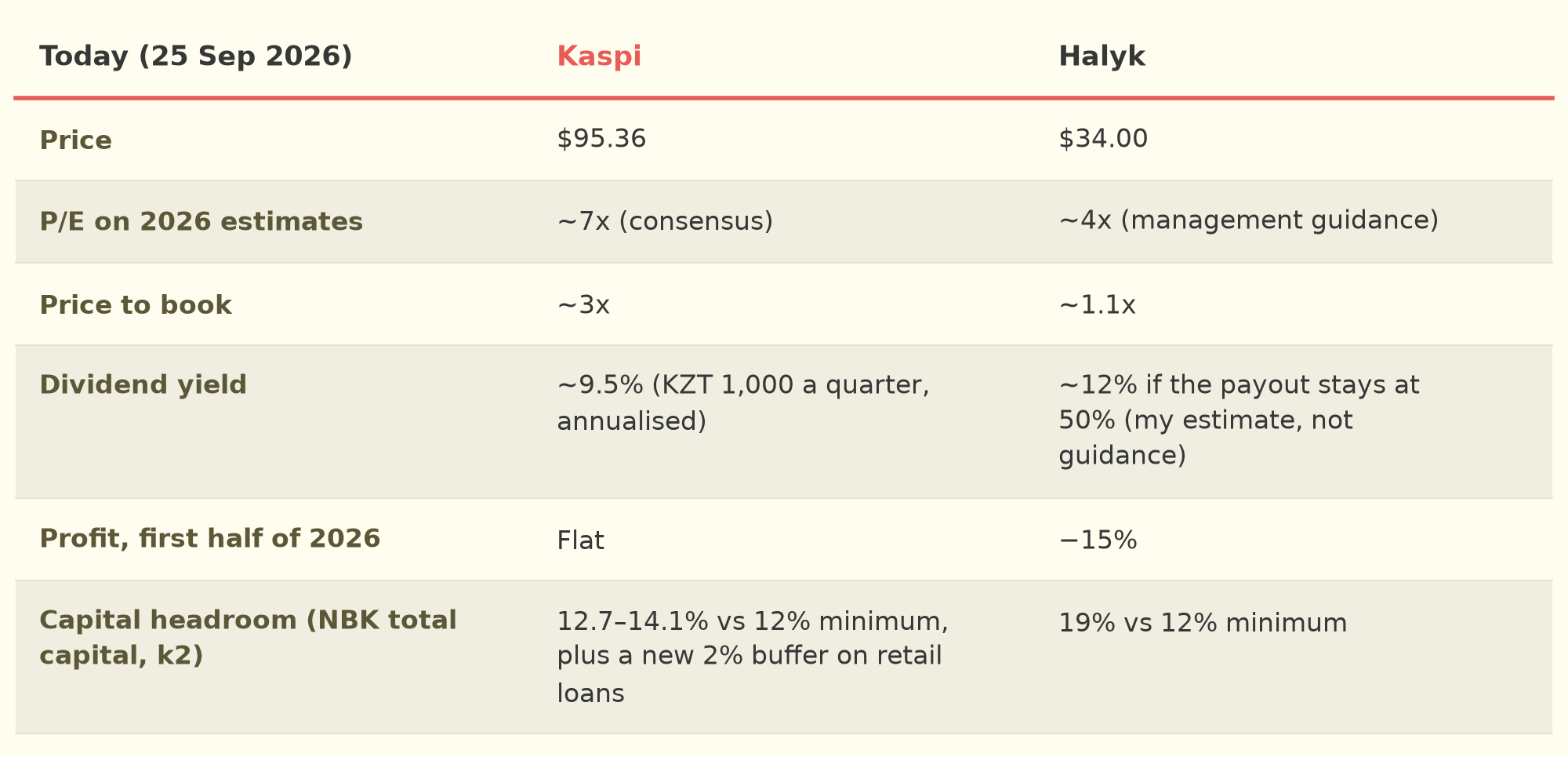
The first thing to notice is that the gap has narrowed, but in the wrong direction — more Kaspi repricing down than Halyk up. In 2023, Kaspi cost four times as much per unit of earnings as Halyk. Today it costs less than twice as much. Kaspi now has a high dividend and a single-digit multiple, which sounds a lot like Halyk in 2023. So has Kaspi become the new Halyk?
In one sense, yes: both have converged. Halyk’s loan book grows roughly with the nominal economy, 13% over the past year and a guided 9–12% for 2026. Kaspi is heading to the same place, although it is not quite there. Its Kazakhstan revenue still grows about 17% a year, a little faster than the economy, and almost all of the extra comes from one engine — advertising and delivery fees on its e-commerce marketplace, which grow around 50% and are now about 8% of revenue. The other side bets I was excited about have mostly run their course. Travel went from +53% to roughly flat, grocery delivery from 3.5x to about +40%, and government services never earned anything directly.
They also face the same new rules. Both have to hold higher non-interest-bearing reserves at the National Bank, both pay the new 25% bank tax, both are exposed to the tighter consumer-lending rules, and both have rising bad loans. At Halyk, 90-day arrears are 5.3%, against 3.0% a year earlier. At Kaspi, non-performing loans rose to 7.0% from 6.1% at year-end. None of this is going away. In the first half of 2026, Kaspi’s revenue grew 23% (15% in the second quarter) and its net income did not grow at all. Halyk’s net income fell 15%.
Where they differ is the rate cycle and what each does with its cash.
The rate cycle now cuts in opposite directions. The base rate has fallen from 18% to 16.25% since June. For Halyk, that means a narrower margin: net interest income grew under 3% in the first half on 13% loan growth, management expects more pressure as deposits reprice, and it calls 12% a realistic floor for the base rate. Fee income is also guided down about 10% this year because of the new lending rules and VAT on some services. Hitting management’s KZT 1T profit target needs the second half to come in about 23% above the first, which looks stretched. For Kaspi, the same falling rates lower funding costs, which reached 14.5% in the second quarter; it has already cut the rate on a third of its deposits. On the cycle alone, the next year or two should favour Kaspi.
But Kaspi carries two risks Halyk does not. The first is a regulator pushing back on its payments dominance. In July the National Bank made a unified interbank QR code mandatory, explicitly worried that Kaspi and Halyk form a payments “oligopoly”, and Kaspi is the one with most of the share to lose. The second is Hepsiburada. It is now about a quarter of group revenue, and Hepsiburada’s inflation-adjusted GMV grew just 2.8% last quarter while its losses doubled. Halyk sends its surplus back to shareholders. Kaspi sends a good part of its surplus to Istanbul. Meanwhile Kaspi’s buybacks have paused, the chairman and Baring Vostok have been reducing their stakes, and Tencent has bought in. The consensus 2026 estimate needs second-half earnings about 22% above the first half. At Halyk, ALMEX still holds about 62% and remains a potential seller.
What would change my mind on each:
Kaspi
second-half earnings that actually meet consensus
NPLs stabilising
Hepsiburada reaching the breakeven management promised
evidence that the unified QR code is not costing it share
buybacks resuming
Halyk
the margin holding up as the base rate falls towards 12%
90-day arrears turning down
a full-year profit near KZT 1T
a payout that stays at or above 50%
So I am selling both.
Kaspi, because the thesis I bought is one I can no longer underwrite. I bought a company that would keep compounding inside Kazakhstan and potentially the region. What is left is a very good domestic franchise whose growth is being absorbed by regulation, a regulator that has started to push back on its payment share, and a large bet on Türkiye that I have no edge in judging (and to paraphrase Munger when he admitted his mistake on Alibaba, Hepsiburada is just a damn retailer). Falling rates will help, and the stock may well be cheap. But “it got cheaper” is not a thesis, and holding on because I once had conviction is exactly the kind of anchoring this post is about.
Halyk, because it is a tracking position that did not graduate to a full position. On 2026 guidance it trades at about 4x earnings, but those earnings were built at the top of a rate cycle that is now turning. If return on equity settles around 20% as rates fall — still a very good bank — profit would be roughly KZT 730B, and today’s price would be about 5.5x that. The dividend would still be generous. It is entirely possible that I open a position in the future again.
Selling both resets the anchors and helps me make an unbiased, or more likely less biased, decision. If either one passes, I will buy it back and tell you why.
The point of the exercise is not to guess which of the two wins the next three years. It is to make sure that this time the decision is about the price and the evidence, and not about which story I would rather tell at dinner.
So What Is Best in Life?
To measure every company with the same ruler, to see the bad news priced in before you, and to hear the dividends land while you wait.